PEACCEL is Exhibiting at BIO International Convention from June 22–25, San Diego, USA.
Stop at Booth 6053 to see how PEACCEL is leveraging AI & Quantum Drug Discovery to transform the industry.
We are looking forward to discussing new innovations and building meaningful partnerships that push the boundaries of medicine.
For pharma and biotech teams: explore faster access to difficult design spaces. For investors and corporate venture teams: see how platform leverage and proprietary therapeutic programs can translate into partnering and out-licensing opportunities.
PEACCEL is a Presenting company: Monday, June 22 3:30 PM Theatre 3
Let’s connect at Booth 6053.
The BIO International Convention is the largest and most comprehensive event for biotechnology, representing the full ecosystem of biotech with 20,000 industry leaders from around the world.
PEGS Boston 2026 is where biologics leaders meet — and PEACCEL will be at Booth 219.
Come see how our Quantum-ready, AI-native platform is expanding peptide and protein engineering for strategic pharma partnering and next-generation therapeutics.
For pharma and biotech teams: explore faster access to difficult design spaces. For investors and corporate venture teams: see how platform leverage and proprietary therapeutic programs can translate into partnering and out-licensing opportunities.
EurIPS 2025, Copenhagen, December 2025. PEACCEL presented new research at EurIPS 2025, a NeurIPS-endorsed European conference bringing world-class generative AI closer to the European ecosystem.
Why this matters for drug discovery and protein design
Generative models for proteins are moving quickly from academic benchmarks toward real R&D workflows: targeted binder design, enzyme engineering, developability-aware candidate generation, and design–build–test–learn (DBTL) acceleration. However, one bottleneck remains under-addressed: evaluation.
For pharma R&D teams, the key question is not only “Can the model generate plausible structures?”, but:
Does it generate diverse candidates without collapsing?
Are candidates stable enough to be worth expensive downstream work?
Is generation efficiency acceptable when compute becomes a real budget line?
For investors, rigorous evaluation is equally central: it is a direct lever for de–risking, repeatability, and time-to-value in a platform that will be judged on outcomes and scalability, not just novelty.
What we presented: FrameBench
We introduce FrameBench: A Principled, Symmetry-Aware Evaluation of SE(3) Protein Generators.
Core idea: FrameBench evaluates SE(3)-equivariant protein generators by making trade-offs explicit across three decision-critical dimensions:
Diversity (how broad and non-redundant the generated designs are)
Stability / domainvalidity (how plausible and usable designs are for downstream pipelines)
Compute-normalized efficiency (what you get per unit of compute, which matters in real industrial cycles)
In the work, we instantiate this framework to compare representative SE(3) protein generative approaches (including diffusion and flow-matching families) and show how FrameBench surfaces actionable trade-offs that are often obscured by single-number reporting.
Where we presented it
FrameBench was presented at PriGM@EurIPS 2025 (Principles of Generative Modeling), a workshop focused on synthesizing foundational principles behind modern generative AI, exactly the type of venue where evaluation methodology and scientific rigor are central.
This work reflects a teamdelivery across PEACCEL and our academic collaborators. We extend a warm thank-you to our partners across the USA, China and France for the sustained collaboration that made this result possible.
What this enables next
FrameBench is part of PEACCEL’s broader effort to make protein generation more predictable, more testable, and more deployable, so that generative models become reliable engines for discovery rather than research prototypes. Concretely, we believe principled evaluation frameworks are a key step toward:
Reducing model selection risk in production discovery pipelines
Improving reproducibility across targets and design objectives
Aligning scientific metrics with business outcomes (time, cost, probability of success)
Let’s connect
If you are:
a pharma/biotech R&D leader exploring generative protein design (or evaluating vendors/models), or
a VC/investor focused on AI-native drug discovery platforms with defensible methodology and scalable execution,
NeurIPS, San Diego, December 2025. PEACCEL presented new research on hypercube- constrained graph learning for protein fitness prediction, emphasizing constraint handling and epistasis modeling, two levers with direct impact on discovery timelines and hit quality.
Hypercube-Constrained Graph Learning to enforce smoothness only where biology supports it (i.e., constraint-aware learning over mutational neighborhoods).
Wavelet-denoised supervision to counter measurement noise and sparsity in sequence–fitness labels, boosting label-efficiency for low-N regimes common in early discovery.
Epistasis-aware prediction on discrete mutational spaces (Hamming hypercubes), improving generalization to unseen variants while respecting feasibility constraints relevant to downstream design.
Why it matters for drug discovery and design
Higher hit rates with fewer assays. Constraint-aware training and denoising reduce experimental burden while preserving accuracy on rugged, epistatic landscapes.
Better transfer to developability filters. Graph-structured outputs and calibrated constraints integrate cleanly with ADMET and safety heuristics.
Collaboration footprint
This work was delivered with academic partners across Australia and the UnitedStates, reflecting a globally distributed R&D model aligned with pharma expectations for translational validation.
Engage with us
If you are exploring AI-driven drug discovery or proteindesign, we welcome a technical discussion.
Event links: NeurIPS 2025 (San Diego, Dec 2–7, 2025): neurips.cc
In July 2025, PEACCEL presented new results at ICML 2025 in Vancouver, including two research contributions and two posters at the GenBio Workshop (Generative AI for Biology), a venue focused on the next generation of generative methods for proteins, RNAs, and small-molecule design.
What we presented
1) Diffusion Models with Group Symmetries for Biomolecule Generation We explore how group symmetries can be built into diffusion models to better reflect the underlying structure of biomolecules, an important lever for improving sample efficiency, validity, and controllability in generative design.
2) Benchmark of Diffusion and Flow-Matching Models for Unconditional Protein Structure Design We provide a practical benchmark comparing diffusion and flow-matching approaches for unconditional protein structure generation, with an emphasis on decision-relevant tradeoffs for real-world R&D: robustness, design quality, diversity/novelty, and operational efficiency.
Plus: Two postersaccepted at the ICML2025GenBioWorkshop, highlighting additional results and perspectives on generative AI for biology.
Why this matters for drug discovery and drug design
Generative AI is increasingly central to biologics and protein engineering because it can:
Compress design cycles by generating plausible structural candidates earlier and at scale
Improve exploration of sequence–structure space beyond incremental local search
Provide more rigorous, comparable evidence when selecting model families (diffusion vs flow-matching) and determining where to invest engineering effort
Our focus is to make generative modeling more physically grounded (via symmetry-aware methods) and more actionable (via transparent benchmarking), so discovery teams can make faster, better-informed decisions.
A global research effort
These contributions were developed with academic collaborators across Germany, France, China, and India, eflecting a genuinely international, multidisciplinary collaboration.
Let’s discuss partnerships and strategic opportunities
If you are:
a pharma/biotech team evaluating generative protein design for discovery programs, or
a VC investing at the AI × Biology frontier
We welcome discussions on platform partnerships, co–development, and strategicfinancing.
🌐PEACCEL at the Cutting Edge of Biopharmaceutical Innovation: Generative AI, Diffusion Models, and Quantum Computing
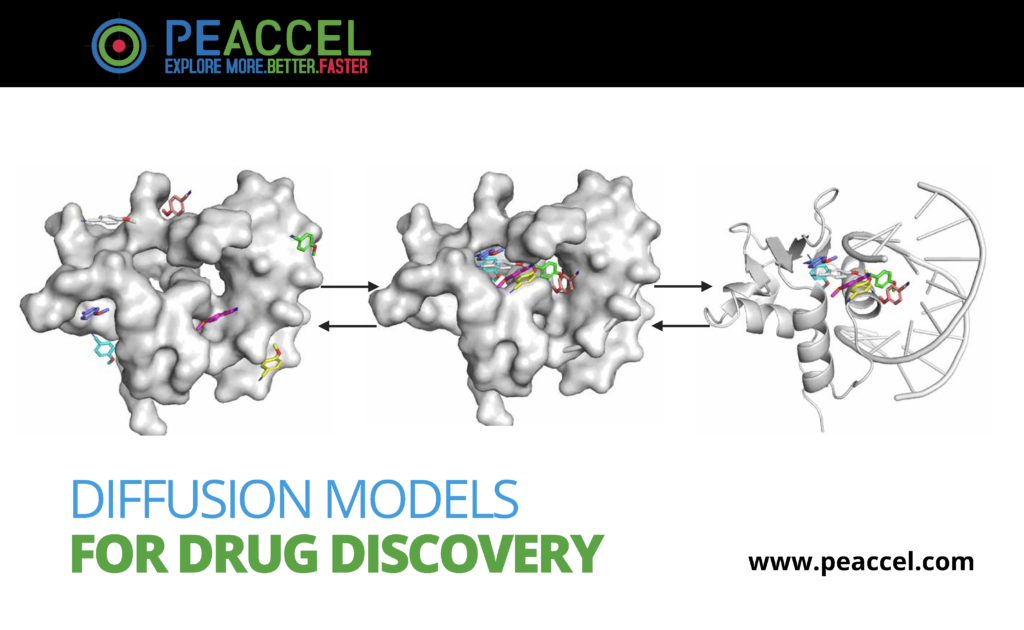
🔬 PEACCEL unveiled its latest research on Diffusion Models in drug design, providing an in-depth analysis of 56 cutting-edge models and their interconnections. These models, including Score-based Generative Models (SGM) and Denoising Diffusion Probabilistic Models (DDPM), are revolutionizing the design of proteins, peptides, and small molecules. We critically examine the role of E(3) and SE(3) equivariance and symmetry in advancing these methodologies.
PEACCEL’s pioneering work positions it as a leader at the forefront of technology, combining the transformative power of Generative AI, Diffusion Models, and Quantum Computing. These advancements are unlocking unprecedented opportunities for pharmaceutical companies and venture capitalists eager to invest in the next wave of biopharmaceutical breakthroughs.
🤝 For partnerships or investment opportunities, connect with PEACCEL and be part of the future of healthcare innovation.
🌐 PEACCEL’s Quantum Breakthrough in Biopharmaceutical Discovery Published in Quantum Information Processing (Springer Nature).
We’re thrilled to announce that our pioneering research paper on Quantum Computing for biologics has been published in Quantum Information Processing! This milestone marks a significant leap forward in pharmaceutical discovery, showcasing the transformative potential of Quantum Machine Learning (QML) in real-world applications.
🧬 The Quantum Leap for Biologics Development
We applied Quantum Support Vector Machine (up to 14 qubits) to classify peptides as hemolytic or non-hemolytic—a critical task with life-saving implications.
Our work paves the way for faster, safer, and more effective biologics, transforming patient care worldwide.
🔍 Collaborative Excellence
This groundbreaking work was conducted in collaboration with the University of Western Australia’s Quantum Physics and Computing team, under the leadership of Prof. Jingbo Wang. For more information: https://doi.org/10.1007/s11128-024-04540-5
We’re thrilled to announce PEACCEL’s pioneering paper in the realm of Quantum Computing for biologics, marking a significant leap forward in pharmaceutical discovery. Our cutting-edge research, conducted in collaboration with the University of Western Australia’s esteemed Quantum Physics and Computing team – Shengxin Zhuang, John Tanner, Yusen Wu, under the great leadership of Prof Jingbo Wang, Ass. Prof Du Huynh, and Ass. Prof Weil Liu – demonstrates the untapped potential of Quantum Machine Learning (QML) in the biopharmaceutical industry.
🌐 Quantum Advantages in Computational Biology 🌐
This research underlines the significant, yet largely untapped, advantages of quantum computing in the field of computational biology. By demonstrating that QSVM can exceed the performance of classical machine learning models, we provide empirical evidence and hope for quantum advantages in real-world applications, particularly in developing safer therapeutic solutions.
🔬 Why This Matters for Pharma 🔬
In our study, we applied the quantum support vector machine (QSVM, up to 14 Qubits) to a crucial task: classifying peptides as either hemolytic or non-hemolytic. According to the French national health database, 160 drugs have been shown to induce autoimmune hemolytic anemia for the period 2012-2018, and 3,371 cases of Drug Induce Autoimmune Hemolytic anemia (DI-AIHA) were recorded (https://doi.org/10.1182/blood-2022-157730). 1% wrong class assignment means more human deaths by hemolysis. A 1% gain in accuracy in healthcare can save many lives.
The implications of this work for the pharmaceutical industry are profound. We can harness the quantum leap to expedite the development of novel biologics and transform patient care worldwide.
We’re thrilled to share an exciting milestone at PEACCEL – our disruptive AI discovery platform for biologics is setting new benchmarks in the pharmaceutical industry. By unlocking previously inaccessible spaces, we are identifying novel, life-changing drugs that were only possible in nature 1% of the time. Imagine the potential when we can screen 1 billion molecules in a single day!
🌐 A Game-Changing Collaboration: PEACCEL & Google Cloud 🌐
Our journey has taken an exhilarating turn as we were handpicked to join the Google Startup Program. This collaboration is not just an endorsement of our innovative approach; it’s a catalyst for exponential growth and impact. Here’s what this means for the pharmaceutical industry:
Massive Scale Screening: From millions to over a billion molecules per day, pushing the boundaries of drug candidate identification from good to the BEST.
Industrial Scale AI: Our platform’s scalability is now supercharged, ready for real-world applications at an industrial level.
Unprecedented Computing Power: Access to a vast array of GPUs, expanding our computing capacity to accelerate drug development, reduce costs, and bring life-saving treatments to market faster.
Robust Infrastructure & Tools: Leveraging Google’s state-of-the-art technology to enhance our research capabilities, foster innovation and drive forward the future of drug discovery.
We are thrilled to announce that PEACCEL has been awarded the prestigious French DeepTech label by BPI France, the public investment bank dedicated to innovation. This recognition is a testament to our commitment to pushing the boundaries of biotechnology with our groundbreaking AI discovery platform for Biologics.